Differential Stains for Identifying Bacteria
Gram, Acid-fast & Endospore
Lab Notes from Science Prof Online
Science Prof Online (SPO) is a FREE science education website. Donations are key in helping us continue to provide this FREE resource.
Please help!
(This donation link uses PayPal on a secure connection.)
Differential stains work by using a series of dyes, and sometimes additional chemicals, to stain bacteria contrasting colors based on structural difference between bacterial cells. The Gram stain, acid-fast stain and endospore stain each reveal distinct information about the bacteria tested.

What the Gram Stain Reveals about Bacteria
The Gram stain, developed by Christian Gram in the 1800’s, was the first differential staining technique in use and is still an important tool for distinguishing between two main types of bacteria—Gram-positive and Gram-negative.
Nearly all bacteria contain peptidoglycan, a molecule unique to the bacterial cell wall. Gram-positive bacteria have a cell wall composed almost entirely of peptidoglycan, present in many layers. Gram-negative bacteria have a cell wall with only a thin layer of peptidoglycan beneath an outer cell wall membranous layer composed of lipopolysaccharides (LPS), an endotoxin that can be harmful to organisms infected with Gram-negative bacteria.
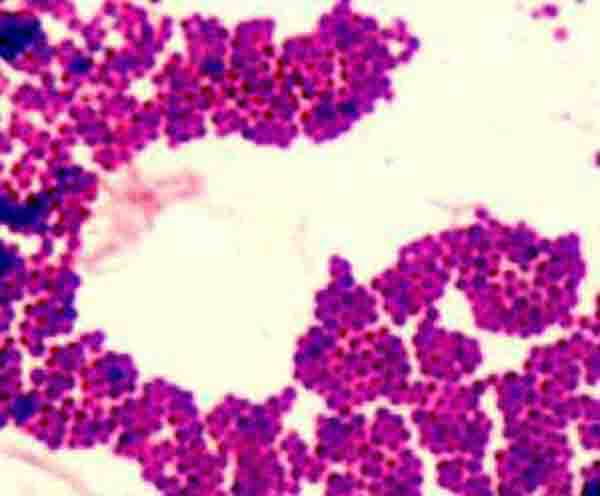
During the Gram staining technique, a purple dye (crystal violet) is first applied to a prepared bacterial smear. After rinsing, iodine is then applied. The crystal violet and iodine bind to create a large molecule that is too big to exit the multiple layers of peptidoglycan in the Gram positive cells, so the purple color becomes trapped. After rinsing, a decolorizer is applied that removes the purple stain from Gram-negative cells, leaving them clear. After rinsing the decolorizer, a secondary stain (safrinin) is then applied to impart a pink color to the Gram-negative cells. After a final rinse, the slide can be viewed under oil immersion with a light microscope. Gram+ cells will appear purple and Gram- cells pink.
What the Acid-fast Stain Reveals about Bacteria
Acid-fast staining, also known as the Ziehl Neelsen stain, is used to identify specialized bacteria that have waxy mycolic acid in their cell wall. The presence of mycolic acid in bacteria is rare, only found in two genera—Mycobacteria and Nocardia. The bacteria that possess mycolic acid are considered “acid fast,” whereas the vast majority of bacteria, those that do not have cell walls containing mycolic acid, are considered “non-acid fast.”
Article Summary: The Gram, Ziehl Neelsen acid fast, and endospore stains are differential tests used to help identify bacteria. Here's how they work.
Gram, Acid-fast & Endospore Stains Lab Notes
Gram stain of Gram+ Staphylococcus 1000xTM+.
During the Acid-fast staining technique, a slide-shaped piece of blotting paper is placed over the bacterial smear, a bright pink dye (Ziehl’s carbolfuchsin) is then applied to the blotting paper, and the slide and paper are placed over a water bath (a steaming pot of water covered with a screen) for 3 – 5 minutes. After this step is completed, the blotting paper is discarded and the slide is rinsed. A decolorizer, acid alcohol, is then applied to remove the stain from non-acid fast cells. Lastly a purple counter stain (crystal violet) is applied and the slide is rinsed. After this staining procedure, acid-fast (waxy) bacterial cells are bright pink and non-acid fast (not waxy) bacterial cells are purplish blue.
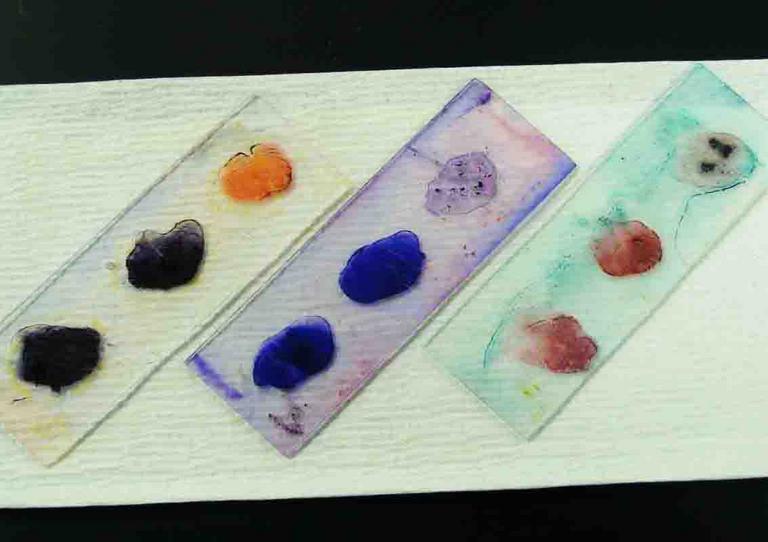
Mixed acid-fast stain showing both Acid-fast (pink) and nonacid-fast (purple) bacteria 1000xTM.
The endospore stain is designed to distinguish vegetative cells of bacteria (active, living cells) from endospores. A bacterial smear is first placed over a water bath and then the stain malachite green is applied. The slide heats on the water bath for five minutes. Then the slide is rinsed and a pink counterstain (safranin) is applied. After the final rinse, vegetative cells will appear pink and endospores are stained a bluish green.
Endospore stain showing endospores (green) and vegetative cells (red) 1000xTM.
Sources
- Schauer, Cynthia (2007) Lab Manual to Microbiology for the Health Sciences, Kalamazoo Valley Community College.
- Bauman, R. (2005) Microbiology. Pearson Benjamin Cummings.
What the Endospore Stain Reveals about Bacteria
The endospore stain is used to identify bacterial cells that can produce endospores—small, dormant structures akin to “bacteria seeds.” Forming endospores is very advantageous to the bacteria that can perform this nifty trick, mainly the taxonomic classes Bacilli and Clostridia. Endospores allow for survival under difficult environmental circumstances, including dessication, starvation, high heat, and exposure to chemicals and radiation.
You have free access to a large collection of materials used in a college-level introductory microbiology course. The Virtual Microbiology Classroom provides a wide range of free educational resources including PowerPoint Lectures, Study Guides, Review Questions and Practice Test Questions.
Page last updated: 4/2012
This article originally appeared on Suite101 online magazine.
Photographic guides to differential stains
now available!